
The US Economic Development Administration's Grantmaking to Indigenous Entities
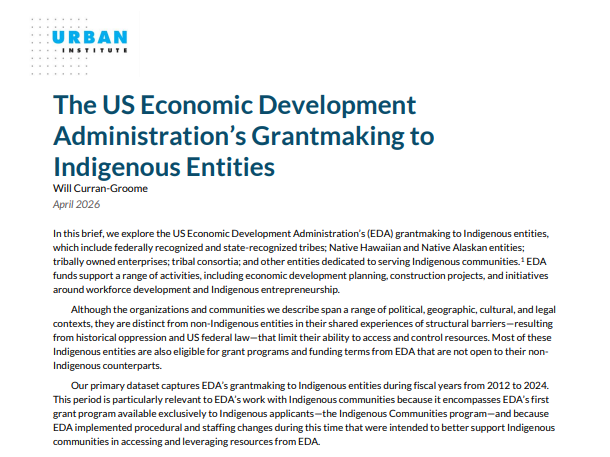
Click to read EDA Grantmaking to Indigenous Entities
Published April 2026
The US Economic Development Administration (EDA) has a long history of funding Indigenous communities’ economic development work. This brief from the Urban Institute describes EDA’s grantmaking to Indigenous communities, presents self-reported economic development priorities from a small survey of Indigenous economic development practitioners, and highlights opportunities for EDA and other federal, state, local, and philanthropic funders to continue to support these communities going forward. We highlight both historical funding trends from EDA and forward-facing opportunities for EDA and other funders to align resources with Indigenous communities’ economic development priorities.
Why This Matters
Indigenous communities, including tribes and Native Hawaiian, Alaskan, and Pacific Islander communities, span a range of political, geographic, cultural, and legal contexts but share structural barriers—resulting from historical oppression and US federal law—that limit their ability to access and control resources. Funding from EDA and other sources is critical to supporting Indigenous communities’ economic development goals.
Key Takeaways
EDA has made over 1,000 grant awards, totaling hundreds of millions of dollars, to Indigenous entities across the US. Its recent Indigenous Communities funding program was a particularly substantial commitment that funded dozens of projects across the country, though this funding program is no longer open. Geographically, we find that awards to Indigenous entities are most prevalent in the western states (including Alaska), which is also where many federally recognized and state-recognized tribes are located.